
Cultivation | CO₂ Sequestration | Carbon Credit | Opportunity | Feasibility
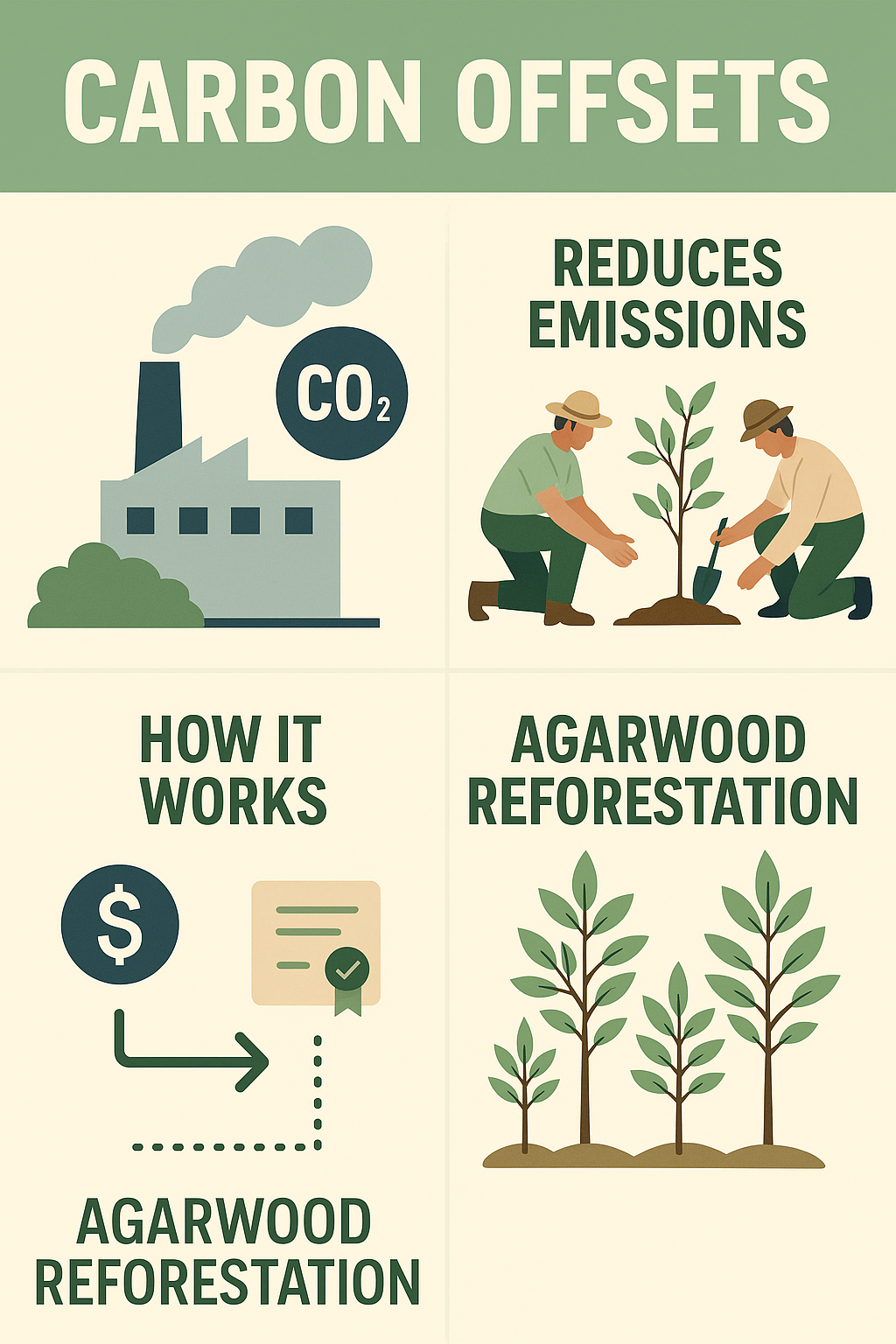
Agarwood (Aquilaria spp.) plantations offer a dual-impact opportunity:
- Environmental restoration & CO₂ sequestration
- High-value product generation via resin (oud)
What Are Carbon Credits?
A carbon credit = 1 ton of CO₂ removed or avoided Companies buy these credits to offset their emissions under:
- Voluntary Carbon Markets (e.g. Verra, Gold Standard)
- Compliance Markets (e.g. for national or sectoral caps)
Why Agarwood?
- Aquilaria spp. are fast-growing tropical trees
- Planted in degraded or idle lands = additional carbon sink
- Carbon is stored in trunks, roots, branches, and soil
- No deforestation—trees remain standing even after resin harvest
- Compatible with agroforestry, increasing total sequestration
How Agarwood Earns Carbon Credits
| Step | Description |
|---|---|
| 1. Baseline Study | Establish existing carbon levels (usually low in degraded lands) |
| 2. Plantation Establishment | Trees are planted at ~1,100 trees/ha |
| 3. Growth & Monitoring | Biomass accumulation measured annually |
| 4. Verification | Auditors assess CO₂ sequestered |
| 5. Carbon Credit Issuance | Verified credits sold to offsetters |
Potential Income (Example)
- 100 hectares of Aquilaria
- Average sequestration: 30 tCO₂e/ha/year
- Over 10 years: 30,000 credits
- At $10/credit = $300,000
Carbon credits can be claimed in parallel with oud resin harvest returns.
Who Buys Carbon Credits?
- Global corporations (Google, Shell, Unilever)
- Airlines, energy firms, and logistics companies
- ESG-driven investors and climate funds
- Carbon brokers and marketplaces (e.g. South Pole, Puro.earth)
Offsetting Benefits for Investors or Developers
- Diversified revenue model (carbon + oud resin)
- Improved project finance eligibility
- Marketing advantage (climate-positive label)
- Eligibility for CSR, ESG or green bond funding
- Can link to NFTs for tree traceability and investor engagement