
Growing Sandalwood | Effective Host | Semi-Parasitic
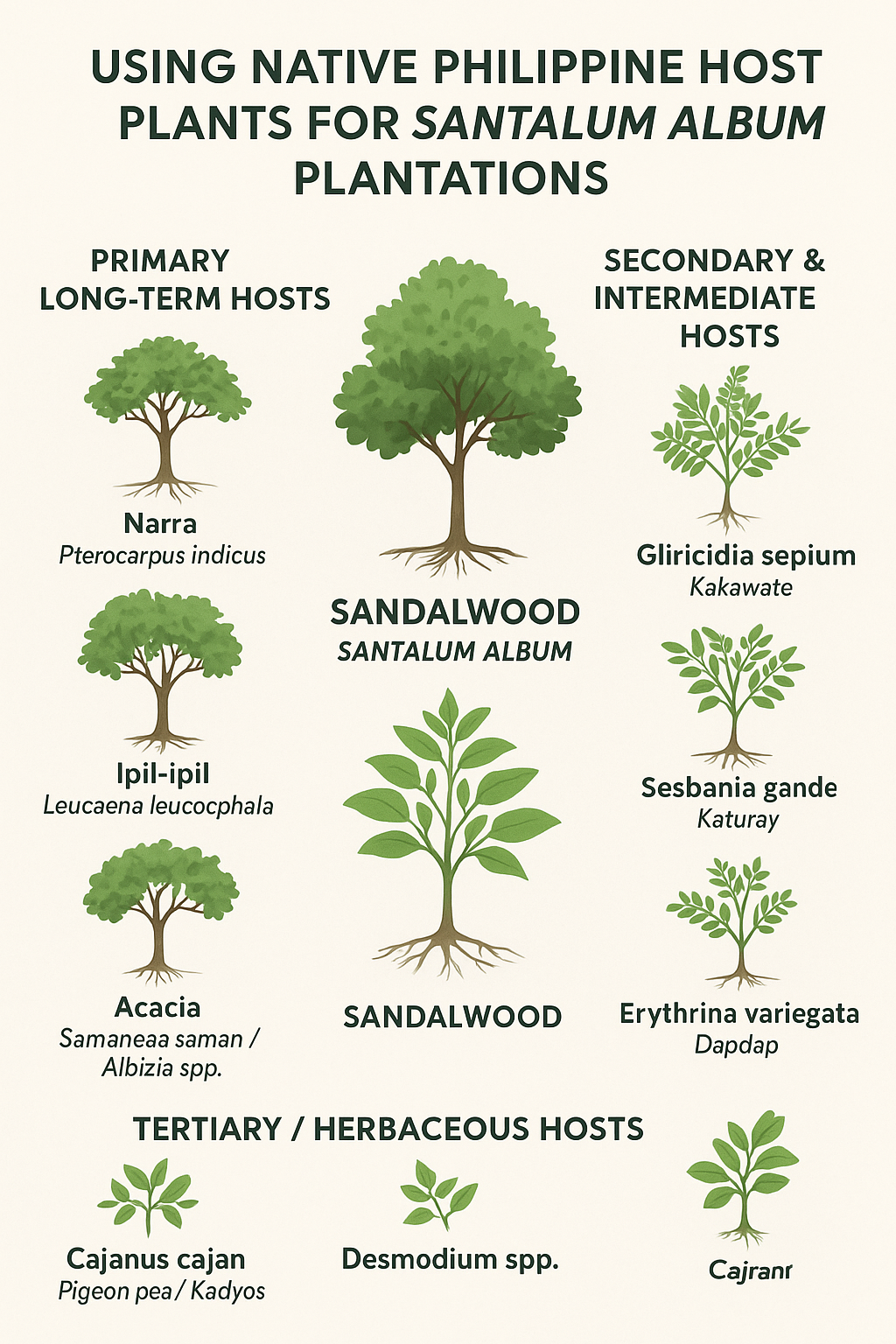
Using native Philippine host plants for Santalum album plantations improves ecological compatibility and sustainability. While Santalum album is not native, it can still thrive when paired with compatible native hemiparasitic hosts and companion species.
Using Native Philippine Host Plants for Santalum album Plantations
Why Host Plants Matter
- Santalum album is a hemiparasitic tree, meaning it photosynthesizes on its own but also taps into the roots of host plants for water, minerals, and nutrients.
- Correct host selection enhances:
- Faster growth rates
- Higher survival and yield
- Stronger oil content and heartwood development
- Soil enrichment and biodiversity balance
Recommended Native Philippine Hosts
(Chosen for root compatibility, abundance, and ecological role)
Primary Long-term Hosts (large trees / N-fixers)
- Narra (Pterocarpus indicus) – deep-rooted, nitrogen-fixing, provides stable nutrient support.
- Ipil-ipil (Leucaena leucocephala) – fast-growing legume, excellent nitrogen fixer.
- Acacia (Samanea saman / Albizia spp.) – strong, wide-spreading roots.
Secondary & Intermediate Hosts (shrubs, short-term companions)
- Gliricidia sepium (Kakawate) – easy to establish, coppices well, improves soil fertility.
- Sesbania grandiflora (Katuray) – fast-growing N-fixer, supports young sandalwood.
- Erythrina variegata (Dapdap) – excellent nurse tree, improves soil organic matter.
Tertiary/Herbaceous Hosts (short-lived, early support)
- Cajanus cajan (Pigeon pea / Kadyos) – provides early root connection, N-fixing, also food crop.
- Desmodium spp. – nitrogen-fixing ground cover.
Ecological Benefits of Using Native Hosts
- Biodiversity conservation – integrates native trees and shrubs, preventing monoculture.
- Sustainability – nitrogen-fixing hosts reduce fertilizer inputs.
- Climate resilience – mixed plantations withstand drought and pests better.
- Community livelihood – intercrop hosts (like pigeon pea, ipil-ipil, katuray) offer food, fodder, and firewood.
Plantation Model (Agroforestry Layout)
- Sandalwood spacing: 3m x 3m (1,100 trees/ha).
- Hosts: Planted alternately within rows:
- Short-lived hosts (pigeon pea, sesbania) for first 2–3 years.
- Medium hosts (gliricidia, dapdap) sustaining until sandalwood matures.
- Long-term hosts (narra, acacia, ipil-ipil) for continuous support through tree’s lifespan.
Summary: Pairing Santalum album with native Philippine hosts like Narra, Kakawate, Sesbania, and Pigeon peaenhances growth, sustainability, and ecological compatibility. This approach ensures a resilient, biodiverse sandalwood agroforestry system that aligns with both economic goals (oil-rich heartwood) and environmental stewardship.